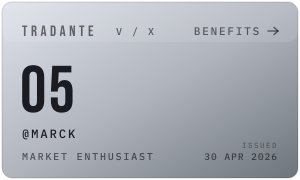
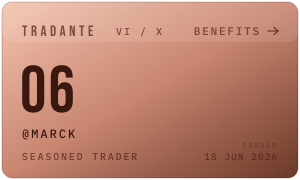
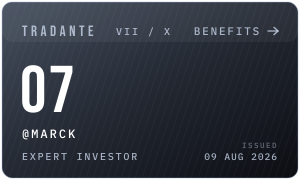
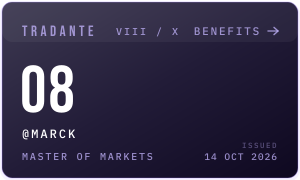
Tradante is a gamified, skill-based trading platform. You trade simulated accounts against real, live prices, across multiple financial instruments: Forex and CFDs, futures and commodities, and the most popular prediction exchange markets. Where available, you can also connect an account you already hold at a supported counterparty and use it in tournaments and leaderboards† (Chapter 15). Challenges and Funded Trader accounts are always simulated.
Cash prizes are awarded for competing: climb the leaderboards, enter tournaments, or develop your social profile by completing achievements and unlocking social events. The social side is a game of its own — show your positions on the Social Order Book™, gain followers and reviews, copy other traders, and sell your own trading signals for cash (USDC) at fees set by your user level.
Tradante also runs a Funded Trader Program. A challenge is a paid evaluation on a simulated account. Traders who pass receive Funded Trader Status and provide Tradante with their trading data, signals and analytics, for which they receive a Performance Reward calculated by reference to their simulated results. Every Challenge and Funded Trader account is simulated, and Tradante takes no position against you on simulated accounts. Program terms are published before you buy, and program payments are recorded on the Base Sepolia blockchain — see Chapter 10.
The whole system is built on top of the Base Sepolia blockchain. Player balances, prize pots and Tradante's program allocations are held in a smart contract: when a result is final, the contract releases the prize directly to the winner's balance, and withdrawals are paid from the vault to the player's verified wallet. Chapter 03 — The Ecosystem explains the full mechanics.
Think of Tradante as a professional trading desk with a game built around it. At the centre sits a full trading interface: real-time market prices, advanced charting, every common order type, and margin and risk controls that behave the way a professional desk expects them to. You use it on simulated accounts, so you can learn, practise and compete on live prices without putting capital into a real market.
Around that desk sit the competitions. Challenges test you against published targets. Tournaments and leaderboards rank you against other traders. Prediction rounds let you call short price moves, and the social floor lets you follow other traders, copy them and sell your own signals. All of it runs on one account balance and one scoring system, so progress you make in one place counts everywhere else.
1.1 How the platform is built
Six ideas hold the platform together. Each has its own chapter later in the Rulebook; the cards below are the short version, with a pointer to where the detail lives.
01
SCORING & PROGRESSION
Every closed trade receives a TPS score (Chapter 07). Scores drive the leaderboards, your level, and your achievements — one system across all products.
02
SOCIAL TRADING
Follow other traders, copy their trades manually or automatically, and see community positions on the Social Order Book™. Each trader controls their own visibility.
03
ON-CHAIN MONEY
Deposits, prize pots, fee splits and payouts are executed by public smart contracts on Base Sepolia and settled in USDC. Chapter 03 documents each program.
04
REVENUE MODEL
Tradante's revenue is the published fee on plans, challenges, tournament entries and signal sales. Trading is simulated, so Tradante holds no market position against users.
05
SKILL-BASED OUTCOMES
Results are determined by trading performance on live market prices. There is no randomness in outcomes, and anti-abuse checks void manipulated scores (2.1.c).
06
ONE BALANCE
You fund a single balance. Every purchase — challenge, tournament, plan — is paid from it in one transaction, and every prize is credited back to it.
1.2 The game loop — from sign-up to payout
Whatever you choose to play, the journey has the same six steps. You fund your balance once, pick a game, trade it, earn a score on every closed trade, climb the levels as your record grows, and get paid to a wallet that is verified as yours.
1
FUND ONCE
Verify your identity, link your wallet, deposit USDC. Your balance is credited the moment the blockchain confirms it.
2
PICK A GAME
Challenge, tournament, prediction round, leaderboard season or the copy-trading floor.
3
TRADE
Real market prices, pro-grade charts, a full order engine — risk rules enforced like the real thing.
4
SCORE
Every closed trade earns TPS. Performance first — with fairness checks built into the formula.
5
CLIMB
Rise through 10 levels. Unlock bigger challenges, higher signal fees, achievements and prizes.
6
GET PAID
Rewards credit your balance at once; prize money follows within 24 hours (4.4). Withdraw to your own wallet — authorized, signed, on-chain.
Heads upSimulated trading, real payments. The trading on your accounts is simulated, but your deposits, entry fees, plan payments, prizes and withdrawals are real USDC payments on Base Sepolia. Treat your balance like any other money, and only spend on entries and plans what you are comfortable spending.
TipNew here? Read Chapter 02 next. Its rules apply to every game on the platform, and the later chapters build on them.
Chapter 02
02
THE GAME RULES.
A skill game is only worth winning if everyone plays the same game. The rules in this chapter apply to every mode, every account and every player, from a free leaderboard run to a paid challenge. Later chapters add rules of their own — a tournament's entry terms, a challenge's targets — but those always add to the rules here; they never replace them.
2.1 The rules of the arena
Seven rules, each with its own number so it can be quoted. If a result, a payout or a review is ever in question, these are the rules it is measured against.
2.1.a
Skill decides. Outcomes come from trading performance — real market prices, real scoring, no randomness in results. You pay to play; performance determines what you win.
2.1.b
One identity, verified. Complete identity verification (KYC) once before money moves in or out. One wallet belongs to one player — permanently.
2.1.c
No offset cheating. The scoring engine detects winning trades hedged by mirror losses in other accounts, and voids those scores.
2.1.d
The market's rules apply. Symbols trade in their real sessions; margin, lot limits and risk thresholds are enforced on every order — the same discipline a live desk demands.
2.1.e
Event rules are published up front. Every tournament, challenge and season states its entry terms, restrictions and prizes before you join — and the money terms are locked in the ecosystem's code.
2.1.f
When earnings reach your balance. Achievement, level and rank rewards land at once. Leaderboard and tournament prize money is released within 24 hours of the close. Referral commissions and Performance Rewards are paid on request, after review. The full rules are in 4.4.
2.1.g
Abuse gets frozen, fairly. Fraud and multi-account detection can hold payouts pending review — and because holds simply pause the payout authorization, your balance itself is never touched.
Not allowedBreaking these rules costs you the results. Running more than one account, offsetting trades between accounts, or playing under someone else's identity voids the scores involved. Prizes and rewards obtained that way can be withheld or recovered, and the account can be suspended or closed — see the Terms of Service.
Your side of itPlay one account, as yourself, and the rules work for you. Every number in the Rulebook — scores, prize splits, fees — is the same for every player, and the rules that decide them are published here before you play.
Chapter 03 · Game transparency
03
THE ECOSYSTEM.
Tradante's money rules are not internal policy. They are enforced by a set of public smart contracts on Base Sepolia that hold the money, move the money, and apply the rules described in this chapter. Balances, fee splits and payouts are recorded on the blockchain, where anyone can verify them.
3.1 Built on Base Sepolia, settled in USDC
The ecosystem is built on Base Sepolia — an Ethereum Layer-2 network developed by Coinbase, secured by Ethereum, with low transaction fees and fast confirmation. The core currency is USDC (USDC ): a regulated, fully-reserved dollar stablecoin where 1 USDC is backed by 1 US dollar. Every price, pot and payout on Tradante is denominated and settled in USDC; the platform has no token of its own.
You hold one balance inside the vault contract, and that balance is your key to the whole platform: it buys challenges, enters tournaments, pays for plans, buys signals — and it's where every prize, fee and payout lands. This is the full life of a dollar inside Tradante:
In
DEPOSIT
You move USDC from your own wallet into the Customer Vault. Your balance is credited when the chain confirms it.
→
Play
ENTER & COMPETE
Entry fees leave your balance and split — most into the event's prize pot or program allocation, the rest to the published platform fee and the rewards treasury.
→
Win
GET PAID
Prizes, signal fees and rewards settle from the vault into your balance as public transactions — on the timing set in 4.4.
→
Out
WITHDRAW
When you want out, the vault pays your own verified wallet. Nothing leaves toward anyone else's.
// every arrow above is a public on-chain event — your deposit, your entry, your prize and your withdrawal can all be checked in a block explorer
3.2 The allocations — where the money sits Live
All money sits inside one vault contract, organized into allocations with distinct jobs. Each allocation is an address in the vault's on-chain ledger — listed below so you can verify it yourself. Nothing is vague about where money is at any moment:
THE CUSTOMER VAULTPlayer balances — yours and everyone's. The only door in and out of the ecosystem. Deposits arrive here; withdrawals leave from here.
PRIZE & PROGRAM ALLOCATIONTradante's allocation for competitions and programs, in dedicated slices: one prize pot per board or tournament, and one program allocation per challenge path, which Tradante uses to run the Funded Trader Program, including Performance Rewards, technology, data acquisition, research and program development. Users hold no ownership, beneficial interest, redemption right or proportional claim in it.
Allocations are entries in the vault's on-chain ledger — check any balance with getBalance(address) on the vault contract.
LATEST ON-CHAIN ACTIVITY · THE VAULTloading from Base Sepolia…
Block
Event
From → To
Amount (USDC)
Tx
Reading the blockchain…
Read live from the Base Sepolia public RPC — the same data anyone can query. Full history: vault on the explorer.
3.3 The engine room — six programs, one job each
The ecosystem is built from six on-chain programs (smart contracts). Each one does a single job, in public, by rules anyone can read — the deployed contract address is listed on each card, and the code itself is the reference for every rule in this chapter:
TreasuryVault
THE VAULT
The heart of the economy. It holds every USDC balance — yours, the prize pots, the program allocations, the reserve — each under its own address. Deposits credit here, withdrawals pay out from here, and every internal move between allocations is a tagged, public settlement. Money never leaves the vault except through a withdrawal you asked for.
For youYour balance is a number on a public blockchain — not an entry in our private database.
Sells challenges — paid evaluations on simulated accounts — at prices and splits fixed when the product is created. On purchase it routes the fee: the program share to the challenge path's program allocation, the rest to the platform. Performance Rewards for Funded Traders are paid from that allocation, and the vault refuses any payment the allocation cannot cover.
For youThe terms you bought under, and every reward payment, are recorded on-chain.
Runs entry-fee events. Each registration locks your fee and splits it on the spot — event pot, platform, awards — by percentages set per tournament. Winners are paid in one public batch, and the program refuses to distribute a cent more than the event's pot actually holds.
For youThe pot you're competing for is real, visible, and can't be quietly drained.
Powers subscription plans: buy or renew a plan, with your plan and its expiry tracked on-chain. Plan payments split like other purchases, except that the prize and awards shares stay together in the awards allocation and reach the leaderboard prize pots day by day over the time the plan was paid for (11.2.m).
For youYour plan and the leaderboard prize pots are both on-chain, so there is nothing to dispute about either.
Settles trader-to-trader signal sales. When someone buys your signal, the sale executes in one transaction: your cut lands in your balance, the platform fee is taken inline — and that fee is hard-capped in the code at 50%, so it can never be quietly raised beyond it.
For youSell your edge and get paid instantly, at terms the code itself enforces.
Pays referral rewards in USDC once they clear anti-abuse checks (no self-referrals, no fake account farms). Every reward is a tagged public payout from a dedicated budget — so the program can't overspend it.
For youReferral rewards are paid in USDC, and every payout is publicly recorded.
PRIZES & PROGRAMS — prize pots and program allocationsAWARDS — rewards & bonusesPROFIT — our published feeRESERVES — platform stability
Nearly every purchase — a plan, a tournament entry, a challenge — splits by percentages written into the ecosystem's code. 60/10/25/5 is the standard shape; each product declares its own numbers before you buy (challenges, for example, split between the challenge path's program allocation and the platform). A plan differs in timing only: its prize and awards shares stay together in the awards allocation and are released to the leaderboards over the paid period (11.2.m). The split executes automatically at the moment of payment. No invoice, no ledger entry to trust — a transaction to check. Every allocation is Tradante's own money, set aside for prizes and programs: users hold no ownership, beneficial interest, redemption right or proportional claim against it.
3.5 What the code guarantees you
YOUR BALANCE IS ON-CHAIN
Your funds are held in the vault under your address — visible in any block explorer, not a number in our database.
EVERY PAYOUT IS PUBLIC
Prize distributions, Performance Rewards and referral commissions are blockchain transactions — auditable by anyone, forever.
PRIZE POTS CAN'T OVERSPEND
An event can only pay winners from what it actually holds — the code refuses to distribute more than the pot holds.
RULE CHANGES ARE PUBLIC
Fees and splits are parameters in the contracts. Any change is a signed, timestamped, public transaction — changes cannot be made silently.
PAYOUTS ONLY TO YOUR WALLET
Withdrawals pay out only to wallets verified as yours. No one can redirect a payout to another address — including platform staff.
NO MARKET POSITION
Trading is simulated, so the platform holds no market position against users. Its revenue is the published fee.
3.6 How rules can change
3.6.a
Tunable rules are public parameters. When a fee or a split changes, the change itself is an on-chain transaction — signed, timestamped, and visible before it affects a single purchase.
3.6.b
Purchased terms do not change. A product's price and split are fixed when the product is created. Changing terms means launching a new product — the terms you bought under stay on record permanently.
3.6.c
Emergency pause. In an incident, the contracts can be paused, which stops all money movement for everyone equally. A pause can stop money from moving; it cannot take money from anyone.
Chapter 04
04
DEPOSITS & WITHDRAWALS.
One wallet, one balance, and a straight line in and out. Your Tradante balance pays for everything on the platform — and everything you win lands right back in it.
4.1 Before your first deposit
4.1.a
Verify once. Identity verification (KYC) is a one-time step, required before money moves in or out. Start it on your desktop and finish on your phone — scan the QR code and complete the ID and selfie check right from your camera.
4.1.b
Link your wallet. Connect your crypto wallet (WalletConnect) and sign a single message to prove it's yours. That wallet becomes part of your identity: it's how you deposit, and it's where your withdrawals go. You can link more than one. A linked wallet is permanent: it can't be removed, and it can never be linked to another account.
4.1.c
Three levels of identity checks. Each level includes the ones before it. User Identification (also called Light KYC): your legal first and last name, date of birth (you must be 18 or older), country, address and a phone number confirmed with a code, filled in once on the "Your details" screen. Standard KYC: identity verification with an ID document and a selfie, through our verification partner Sumsub; it starts once User Identification is complete. Enhanced KYC: additional documents we may ask for after Standard KYC, such as proof of address or of the source of funds. We tell you when a step is needed.
4.2 Depositing
4.2.a
Deposit USDC on Base Sepolia. USDC is a fully-reserved digital dollar; Base Sepolia is the fast, low-fee network it moves on. Connect, choose the amount, confirm — fees cost cents and the network does the rest. Other accepted tokens, such as ETH, are credited at their USDC value at the moment the deposit arrives.
4.2.b
Credited when the chain confirms. Your balance updates the moment your deposit is confirmed on the blockchain — typically seconds. Not when we say so; when the chain says so.
4.2.c
Only from your own wallet. Deposits are accepted only from wallets linked to your account. It's an anti-fraud shield: nobody can fund your account to manipulate you, and you can't be tricked into funding someone else's.
4.2.d
Your balance is your money in the vault. The balance you see is read from your own slice of the vault. If it can't be read, the app says so; it never shows a zero in its place.
4.2.e
Security codes. Some actions are confirmed with a code. An email code is sent to your email address. A phone code is texted to your confirmed phone number. An authenticator app code is the 6-digit code shown by an app such as Google Authenticator, Microsoft Authenticator or Authy, set up once in My Account. Backup codes are one-time codes you receive when you set up the app; each one can be used once in place of an app code if you lose your phone. Withdrawals always need an authenticator app code or a backup code, never a texted code; you can set up the app right in the withdrawal window. A code you entered a few minutes earlier still counts, so you're not asked twice.
4.2.f
Bank transfer. You can also add funds by bank wire, from an account in your own name, using the details shown in Add funds. Once you have sent it, press “I’ve made the transfer” with the reference you wrote: it shows as a pending deposit in My account › Tokens. We add it to your balance when the money reaches our bank, usually in 1–3 business days, for the amount that actually arrived. A transfer that never arrives, or that is not in your name, is not credited. Up to 3 transfers can wait at a time.
4.3 Withdrawing
4.3.a
Withdraw by request. Ask for a withdrawal from your balance. Our team reviews each request, usually within a few hours, and then it is paid to your linked wallet as USDC — an on-chain transfer you can watch land in a block explorer. The amount is set aside from your balance while it waits, and you can cancel the request until it is paid. Published limits apply: a minimum amount, one request at a time and a daily maximum.
4.3.b
Every withdrawal is individually authorized. Each withdrawal is signed off by the platform and executed by the vault — a two-key handshake that means stolen sessions or bugs can't drain anything.
4.3.c
Withdrawals go only to your wallets. Money only ever leaves toward wallets verified as yours. No one can redirect a payout to another address — including platform staff.
4.3.d
Earnings are not withdrawals. Prizes, rewards and commissions move into your balance under the rules in 4.4. You only withdraw when you want money out of Tradante entirely.
4.3.e
Network fee. Your first withdrawal each calendar month is free. After that, a small network fee (currently 0.10 USDC) is deducted from each withdrawal; the review screen shows it before you confirm.
4.3.f
Security holds. After you change your password, replace or remove your phone number, or remove your authenticator app, you can't withdraw for 48 hours. The first withdrawal to a newly linked wallet also waits until 48 hours after the wallet was linked. The withdrawal window tells you when you can withdraw again. Setting up your first phone number or authenticator app does not start a hold.
4.4 Payouts: when earnings reach your balance
A payout moves money from a prize pool, the referral program or the program allocation into your own balance. It stays inside Tradante until you withdraw it.
4.4.a
Titles at once, prize money after a 24-hour review. When a leaderboard or tournament closes, ranks, medals and badges are assigned immediately. Prize money waits up to 24 hours so the results can be checked: it can be released earlier, and with no decision it is released automatically when the 24 hours end. If a check is still under way, the prize stays held until it is finished. A prize that is rejected is not paid: its money stays in its prize pool, nobody's entry is refunded and the other winners are paid as normal. You are told the reason.
4.4.b
Rewards land at once. Achievement, level and rank rewards are credited to your balance the moment they are earned.
4.4.c
Refunds are instant. A cancelled tournament, leaving one before it starts, a refunded challenge or a plan credit returns your money to your balance immediately.
4.4.d
Paid services are paid in advance. Signals and copy trading are charged up front from the buyer's balance, so a provider is never left unpaid.
4.4.e
Commissions and Performance Rewards are paid on request. A referral or partner commission (14.2) can be requested once it has matured, up to 30 days after the sale depending on your level or contract. A Performance Reward (10.3) can first be requested after the minimum trading days of your challenge, then as often as your plan allows (11.2.l); the amount is your profit times your account's split. Each request is reviewed; once approved, it is paid in full.
4.4.f
Fair play can hold or reverse a payout. While an account is under review, its payouts are held. If a payout turns out to come from a breach of the rules, it can be taken back from the balance, and withdrawals are paused during the investigation.
4.4.g
You always see where it stands. Each payout shows its status, such as releasing in a number of hours, under review, or held with the reason, and you are notified at every change.
4.5 Your wallet at a glance
My Wallet · USDC on Base Sepolia
2,480.50USDC
DEPOSITWITHDRAW
Weekly leaderboard prizereleased after the 24-hour settlement
+120.00
Depositconfirmed on-chain · 0x7f4a…c218
+500.00
Signal sale — 3 followerssettled on-chain
+45.00
↗
Withdrawal to your walletsigned & paid · 0x8b91…3a07
−300.00
Illustrative view — numbers are examples
Good to knowWhy USDC and not a platform token? USDC (USDC) is a regulated, fully-reserved dollar stablecoin: 1 USDC is backed by 1 US dollar, so the value of a prize does not fluctuate with a token price. And because it lives on a public chain, your balance is visible in the vault under your own address at all times.
Chapter 05
05
ACHIEVEMENTS.
Badges for the feats worth bragging about. Achievements mark special accomplishments — and some come with prizes attached.
5.1 How badges work
EARNED, NOT GIVEN
Each achievement has a concrete task behind it — win a leaderboard, string together 5 or 10 consecutive winning trades, and many more waiting to be discovered.
SOME ARE REPEATABLE
Certain badges can be earned again and again — every repeat shows on your profile and keeps the streak culture alive.
SOME PAY OUT
Selected achievements unlock prizes credited straight to your balance, and they count toward your level progress too.
5.2 The badge gallery
Tournament winner
10-win streak
Weekly board winner
Funded trader
Real badge art from the platform — a few of the shields you can earn
TipWhere they show: achievements live on your public profile next to your rank and level — the résumé other traders see before they follow or copy you.
Chapter 06
06
USER LEVELS.
There are ten user levels. Each level has published requirements to advance, and each unlocks specific capabilities.
6.1 The ten levels
1
2
3
4
5
6
7
8
9
10
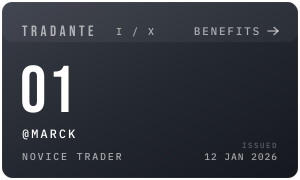
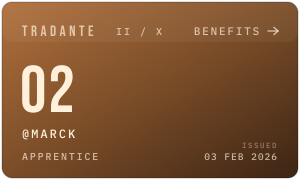
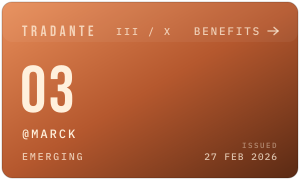
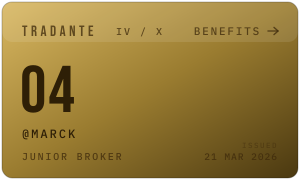
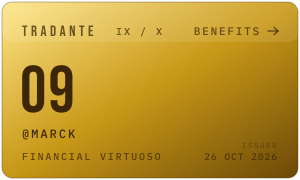
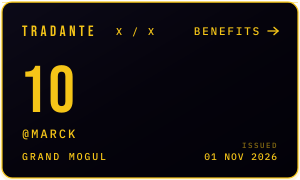
Real level cards from the platform — steel at 1, platinum at 5, obsidian & gold at 10
6.2 What each level asks
Advancing a level means completing that level's mix of requirements — three kinds:
Requirement type
TRADING MILESTONES
TPS thresholds, achievements earned, trading activity — proof you can actually trade.
Requirement type
SOCIAL GOALS
Followers gained, reviews received — proof the community rates you.
Requirement type
ACCOUNT STEPS
Account validation, identity verification — proof you're playing as yourself.
6.3 What levels unlock Live
6.3.a
Higher referral commissions. Your level sets the commission rate you earn on your referrals' purchases (Chapter 14). The rates for each level are in the table below.
6.3.b
Higher signal fees. Your level caps the fee you can charge as a signal seller. The cap for each level is in the table below.
Level
Referral: first / repeat purchase
Referral: indirect first / repeat
Commission payable within
Max signal fee
1 · Novice Trader
— / —
— / —
30 days
5 USDC
2 · Apprentice Investor
5% / —
— / —
30 days
7 USDC
3 · Emerging Speculator
10% / 5%
— / —
30 days
9 USDC
4 · Junior Broker
10% / 5%
5% / —
21 days
45 USDC
5 · Market Enthusiast
10% / 5%
5% / 5%
21 days
50 USDC
6 · Seasoned Trader
15% / 10%
10% / 5%
14 days
55 USDC
7 · Expert Investor
15% / 10%
10% / 10%
14 days
60 USDC
8 · Master of Markets
15% / 12.5%
10% / 10%
14 days
65 USDC
9 · Financial Virtuoso
17% / 12.5%
15% / 15%
1 days
62 USDC
10 · Grand Mogul
20% / 15%
15% / 15%
—
72 USDC
This table is read live from the platform's settings, so it always shows the current values. A dash means the benefit is not set for that level.
Chapter 07
07
TPS & RANKING.
One number carries your reputation: the Trade Point Score. Every closed trade earns it. Everything competitive runs on it.
7.1 How the score works
EVERY TRADE COUNTS
Close a trade, earn TPS — scored in real time, visible immediately on your profile and every board you're on.
PERFORMANCE FIRST
The score is driven by how well you traded: the return, the risk you took, whether you exited on a plan and how steady you have been. Account type and level shape it last.
CHEAT-PROOF BY DESIGN
The formula detects winning trades offset by mirror losses in other accounts and voids them. The score you see is a score that was earned.
TipWhere TPS takes you: your score drives your leaderboard rank, your tournament standing and your level progress — one engine behind every ladder in the game.
TPS measures how well you traded, not how much money you moved. Every closed trade is turned into a percentage of the account it was taken on, then into points. How you traded it shapes those points (7.6), and two factors scale the result: your account type and your level.
TPS=result of the tradebalance before the trade×1,00010 pts per 1%×riskreference ÷ your risk×exitplanned or not×qualityyour last 30 days×account factortype of account×level factoryour level at close
A 1% gain is 10 points before the factors, a 1% loss is −10. The risk, exit and quality factors are explained in 7.6. The score is rounded to three decimals.
7.1.a
Percent of the account, not money. The result of a closed trade is divided by the balance of that account just before the trade. 100 earned on a 1,000 account and 1,000 earned on a 10,000 account are both 10% and score the same.
7.1.b
Ten points per percent. One percent gained is 10 points and one percent lost is −10, before the factors. Losses score negative: your TPS can go down.
7.1.c
Account factor. The type of account the trade was taken on scales the points. Practice on a demo counts for less than a challenge, and a funded account counts the most. The current values are in the table below.
7.1.d
Level factor. Your level at the moment the trade closes scales the points. Each level from 1 to 10 has its own factor, and an unranked account earns the least.
7.1.e
Nothing earned, nothing scored. A trade that closes with no result earns zero. Opening and closing trades for no result is not a way to earn points. A result too small to show after rounding keeps its sign as ±0.001.
7.1.f
The factors are settings. Every factor and rule is a platform setting and may be tuned between seasons. A change applies to trades closed after it. A trade that has been scored is never re-scored.
7.1.g
After costs. The result used is what the trade made after its costs: the commission on FX trades and the fees on prediction contracts are taken off first. A trade that made 10 and paid a 3 commission scores on 7; a trade that made 2 and paid 3 scores as a loss of 1.
7.1.h
Gross and net. Gross PNL is the result of a trade before commission and fees; net PNL is the result after them. Commission and fees are part of the cost of a trade, so a trade is a win only when its net PNL is above zero: a trade that closes positive and ends negative after commission is a losing trade. Win counts, winning streaks, medals, funded profit and withdrawals all use the net result, with no exception.
The two factors
Account type
Factor
Demo
× 0.40
Challenge
× 1.00
Evaluation
× 1.10
Live
× 1.20
Funded
× 1.30
Level
Factor
Unranked
× 0.40
1 · Novice Trader
× 0.60
2 · Apprentice Investor
× 0.80
3 · Emerging Speculator
× 0.90
4 · Junior Broker
× 1.00
5 · Market Enthusiast
× 1.05
6 · Seasoned Trader
× 1.10
7 · Expert Investor
× 1.15
8 · Master of Markets
× 1.20
9 · Financial Virtuoso
× 1.25
10 · Grand Mogul
× 1.30
Read live from the platform's settings, so the table always shows the current values.
Worked examples
#
Account
Balance before
Result
Percent
Before factors
Account × level
TPS
1
Demo, level 4
10,000
+100
+1.00%
+10.0
0.40 × 1.00
+4.000
2
Funded, level 7
100,000
+1,000
+1.00%
+10.0
1.30 × 1.15
+14.950
3
Challenge, level 2
50,000
−1,500
−3.00%
−30.0
1.00 × 0.80
−24.000
4
Live, level 4
2,000
+300
+15.00%
+150.0
1.20 × 1.00
+180.000
5
Demo, level 10
10,000
0
0.00%
0
0.40 × 1.30
0
Rows 1 and 2 are the same 1% trade: the funded trader at a higher level earns almost four times the points of the demo trader. Row 4 shows why TPS is about percent: 300 on a 2,000 account is a big trade. Row 5 earns nothing, whatever the level.
Good to knowWhy two factors? Practice is cheap and risk is real. The account factor keeps a demo win from outranking a funded one, and the level factor rewards traders who have proven themselves over time. Neither factor can turn a loss into points.
7.2 Your performance line
TPS is a competition score. Your performance line is the other view of the same trades: one curve, in percent, that shows how well you trade across every account you use, whatever its size or type.
7.2.a
Every trade is measured in percent of its own account. A trade's result is its profit or loss divided by the balance of the account it was taken on, just before the trade. Earning 100 on a 1,000 account and 1,000 on a 10,000 account are the same 10%.
7.2.b
Results compound in time order. The line starts at 100 and is multiplied by each trade's result in the order the trades closed, across all your accounts. 125 means your trading has compounded 25% since your first trade; the change between two dates is your return for that period.
7.2.c
Same account factor as your score, no level factor. Each trade's percent is scaled by the account factor of 7.1.c before it enters the line, so a demo trade moves the line less than a funded one, exactly as it earns fewer points. The level factor is not applied: your level is read from this line (chapter 6), so the line cannot feed itself. The score and the line therefore use the same inputs; they differ only in the arithmetic, explained in the example below.
7.2.d
Closed trades only. Open positions are not in the line. Account resets and new challenges do not distort it, because each trade is measured against its own account at the time.
7.2.e
Which accounts count. Every account type is in the line. You can filter it by account type to see, for example, your funded or your prediction trading alone.
7.2.f
A floor under the balance. The balance used is the balance of the account before the trade or the floor, whichever is higher. The floor is a platform setting, currently 250. It stops a nearly empty account from turning a small result into a huge percentage: without it, a small loss on an account holding almost nothing would count as losing everything and take the whole line to zero.
7.2.g
After costs too. The line, and the returns shown on the leaderboards, use the result after commission and fees, the same as the score (7.1.g).
Why the score and the line can disagree
Points add; the line multiplies. Three trades on a challenge account at level 4 (both factors 1.00): +10%, +10%, then −20%.
#
Percent
TPS for the trade
TPS running total
Line before
Line after
1
+10%
+100
+100
100.0
110.0
2
+10%
+100
+200
110.0
121.0
3
−20%
−200
0
121.0
96.8
The points say break-even. The line says −3.2%, because the 20% loss was taken on 121, not on 100, and cost more than the two gains together. Both are right about what they measure: the score is what you collected, the line is what your money did. With small trades the two stay close; big swings pull them apart.
7.3 Which trades count where
Every closed trade is scored. Where the points land depends on when the trade opened and closed.
Two weeks on the board clock. Each bar is one trade from open to close; a lit letter means the trade counted for that board. Every one of A to D is scored for the all-time ranking the moment it closes. E has no score until it does.
7.3.a
Scored at close, always. TPS is calculated when a trade closes and always counts in your total score and the all-time ranking. An open position has no score.
7.3.b
A board counts a trade only if it opened and closed inside that board's period. A trade opened today and closed tomorrow is on neither day's board; it counts for the week and the month when both the open and the close fall inside them. A board day ends at the reset time in Chapter 08.
7.3.c
Tournaments use the same rule. A trade counts for a tournament only if it opened and closed while the tournament was running. A position opened before the start never counts, and a position still open at the end is not scored for it.
7.3.d
You are told where the points landed. The score notice says which boards a trade counted for, and your trade log marks every trade with D, W and M, lit when it counted for that board.
7.4 Open positions, hedges and parked trades
7.4.a
An open position earns and costs nothing. A losing position left open is not scored until you close it; it is scored then, under 7.3. Leaving a loser open cannot produce points, it only delays a negative score. The one exception is 7.4.d.
7.4.b
Opposite positions are scored on the net. If you close a trade while you hold an opposite position on the same symbol, in any of your accounts, the result is netted against that position's open result at that moment and only the net is scored. The part already counted is not scored again when the other side closes. A full hedge earns zero.
7.4.c
Netting comes before multipliers. The net is taken on the raw result across all your accounts, before any account-type or level factor, so a hedge between a demo and a challenge or funded account earns nothing. Opposite positions across your accounts are also against the challenge and funded program rules (Chapter 10).
7.4.d
A winner closed beside an open loser is scored on the net. If you close a trade in profit while you hold a losing position in the same direction on the same symbol, in any of your accounts, the open loss on the same size is taken off the result and only the net is scored, worst entry first. The part already counted is not scored again when the losing position closes.
Worked example · a hedge across two accounts
Step
What happens
Raw result
Counted on the other side
Scored
1
Buy 1 lot EUR/USD at 1.1000 in a challenge account and sell 1 lot EUR/USD at 1.1000 in a demo account. Nothing scores: both positions are open.
—
—
0
2
The price is 1.1050. The buy is closed for +500. The sell is still open at −500, so the two cancel out.
+500
−500, the open sell
0
3
The price is 1.1060. The sell is closed for −600. The −500 was already counted at step 2, so only the rest is scored.
−600
−500, counted at step 2
−100
Across both accounts the trader lost 100 and the score says −100. Without netting, step 2 alone would have scored +500 while the loss sat unscored in the other account.
−100
−100
Results in account currency for a 1-lot position. −100 on a 10,000 account is −1%, −10 points before the factors.
7.5 Scoring predictions
A prediction is a trade. You stake part of your virtual balance on an outcome at the market's price, and the position closes when you sell it or when the market resolves. It is scored with the same formula and in the same points as any other trade, with a few rules that fit the shape of a prediction: a loss capped at the stake, and a win that can be many times it.
7.5.a
Same formula, same points. The result is what the position paid out minus what it cost, divided by the virtual balance before the position was opened, ten points per percent, then the account and level factors. Prediction points are never handed out as prizes: every point comes from a result measured against your balance.
7.5.b
A floor under the balance. The balance used is your virtual balance before the position or the floor, whichever is higher. The floor is a platform setting, currently 250. It stops a nearly empty balance from turning a small win into a huge percentage.
7.5.c
A cap on one position. No single position can score more than 50% of the balance, in either direction, before the factors: 500 points at factor 1. A long shot still pays well, but one lucky ticket cannot own a week. The cap is a platform setting.
7.5.d
Resolution is a close. When a market resolves, your position closes at 1 if you were right and at 0 if you were wrong, and that close is scored like a sale. A market that is voided or cancelled returns the stake, scores nothing and does not count as a trade.
7.5.e
Yes and No on the same market are opposite positions. Holding both sides of one market is a hedge and is scored on the net under 7.4, with the market as the symbol.
7.5.f
Tiny results still score. A position that closes less than 1 cent from its entry price scores +0.001 or −0.001, by its result after fees, and nothing only when that result is exactly zero (7.6.a). Flipping a position for a tick is not a way to earn points.
7.5.g
Boards follow 7.3. A position counts for a board or a tournament only if it was opened and closed, or resolved, inside the period. A pick that resolves next week is on next week's board, not today's.
7.5.h
Prices are live. Every position is priced at the live market price at the moment it is placed. An order against a price that is no longer current is rejected, so there is no stale price to trade against.
7.5.i
Weight. The virtual prediction balance carries the demo account factor: nothing is at stake, so it earns at the demo rate.
7.5.j
Scored once, corrected by addition. A position is scored once, when it closes. If a resolution is later corrected, the difference is scored as a new entry; a scored entry is never edited.
7.5.k
Stake limit. On a simulated account you cannot have more than 25% of the account's balance staked on one market, positions and working orders together: an order that would go above it is refused. This is a game rule, not part of the formula, and it is a platform setting. Live accounts are not limited.
A win with 10% of the balance at stake. The dashed line is the raw result: the cheaper the entry, the bigger the win. The solid line is what is scored. A loss is always the stake, −10% here, whatever the entry price.
Rows 1 to 3 are the same position with three endings. Rows 4 and 5 are a long shot: it pays 19 times what it risks, and loses only its stake. Row 6 would score 900 points without the cap and row 7 would score 100 without the floor: a lucky ticket and an empty balance are the two ways a position could outscore a month of trading, and both are closed.
Heads upSettings, not promises. The floor, the cap, the tiny-result threshold and the stake limit are platform settings; the values above are the current ones. A change applies to positions opened after it.
7.6 How you traded it
Two trades with the same result can be very different trades. The score looks at how the result was reached: whether price really moved, how much of the account was at risk, whether the trade closed on a plan, and how steady your recent trading has been. These checks sit between the result and the account and level factors.
7.6.a
A trade must move. Price has to travel at least 0.02% of the entry price between open and close (1¢ on a prediction contract). A trade that moves less scores only the smallest step: +0.001 when its result after commission and fees is positive, −0.001 when it is negative, and nothing when it is exactly zero. Round-trips on market noise earn next to nothing. How long you hold does not matter: a two-minute trade and a three-day trade are judged the same way.
7.6.b
Risk shapes the points. The money a trade could lose at its stop-loss, as a percentage of the balance before it, is its risk. The points are multiplied by 2% divided by that risk, between ×0.25 and ×2. A trade that risked 2% scores ×1. The same result with half the risk scores twice as much, with twice the risk half as much. The factor is the same on a gain and on a loss: a trade stopped out has lost exactly what it risked.
7.6.c
The widest stop counts. Risk is measured at the widest point your stop-loss reached while the trade was open. Setting a tight stop and widening it later does not lower the measured risk.
7.6.d
No stop means undefined risk. A trade with no stop-loss within 5 minutes of the open, or whose stop was removed, has undefined risk. A gain on it is multiplied by ×0.5 and a loss counts in full, so trading without a stop always scores worse than trading with one. On a prediction the contract price already caps the loss, so its risk is always defined.
7.6.e
A planned exit earns a bonus. A trade closed by its own take-profit or stop-loss followed a plan, win or lose. A gain is multiplied by ×1.1 and a loss by ×0.9. The level must be set at least 5 minutes before the close and sit at least the minimum move away from the entry. A manual close scores normally. On predictions a fill on your resting take-profit order counts; settlement at expiry does not. Only the part of a position closed by the level gets the bonus.
7.6.f
Your last 30 days set the quality factor. It reads your closed trades of the last 30 days across all your accounts, each as a percent of its own account. Consistency: your best day should be no more than 35% of the profit. Profit factor: gains divided by losses, full marks at 2. Drawdown: the deepest fall of your return curve, neutral at 10 points. Together they give a factor between ×0.5 and ×1.5. With fewer than 10 trades in the window the factor is ×1.
7.6.g
Quality works both ways. On a gain the points are multiplied by the quality factor. On a loss they are multiplied by 2 minus the factor, so a steady trader's loss costs less and an erratic trader's loss costs more.
7.6.h
Then account and level. The account and level factors of 7.1 apply last. Every number in this section is a platform setting, shown here as it is now. A change applies to trades closed after it.
Rows 2 and 4 are one plan, a 1% stop and a 1% target: the win earns more than the loss costs only by the planned-exit bonus, so a plan with no edge stays near zero. Rows 3 and 5 are the same trades without a stop: the win is cut and the loss is not, so trading without a stop loses points over time. Rows 6 and 7 show a steady month lifting the win and softening the loss. Row 8 earns nothing, whatever the result.
Chapter 08
08
LEADERBOARDS.
Five ranking boards run continuously. The Daily, Weekly and Monthly boards can pay prizes; the General board shows ranking only; each tournament has its own pot (Chapter 12). Your subscription plan decides which boards you compete on (see 11.4).
8.1 The boards
Board
Cycle
How it works
DAILY
Each board day ends at 00:00 UTC
24-hour ranking cycle; prizes are settled at each daily close.
WEEKLY
The week ends with Saturday's board day
7-day ranking cycle; prizes are settled at the weekly close.
MONTHLY
The month ends with its last board day
Calendar-month ranking cycle; prizes are settled at the monthly close.
GENERAL
Ongoing
Ranking only. The General board pays no prize.
TOURNAMENT
Per event
Each tournament runs its own TPS ranking with its own prize pot (Chapter 12).
8.2 The prize pools now Live
Leaderboard prize pools are funded only by plan purchases: the prize share of every plan payment is divided between the boards by the percentages in 8.4. Each pool is an address in the vault's on-chain ledger, so anyone can check its balance.
Balances are read live with getBalance(address) on the vault contract. Pool money is Tradante's prize money; users hold no claim on it until a prize is awarded to them.
8.3 Board rules
8.3.a
Ranked by TPS. The same score from Chapter 07 — no separate formula, no hidden weighting.
8.3.b
Who can win. Your plan decides the boards you can win on (11.4). To count on a board you need the minimum number of closed trades in that period shown in 8.4, and only a positive TPS can win.
8.3.c
A board needs enough players. If fewer eligible traders than the minimum shown in 8.4 took part, the board closes with no medals and no prize, and its pool money stays in the pool (8.5.d).
8.3.d
Medals. The top three positive scores take gold, silver and bronze medals and the matching achievements (Chapter 05). Medals are separate from prizes: the prize places are set per board in 8.4.
8.3.e
Ties. If two traders end a period with exactly the same TPS on a board, the trader with the better position on the master leaderboard is placed first; if that is also equal, the higher user level; if still equal, the earlier registration date.
8.4 What each board pays now Live
Board
Prize
Paid places
Minimum players
Minimum trades
Share of plan prize money
DAILY
Free challenge: Instant · Multi-Asset
1
2
1
—
WEEKLY
Share of the weekly prize pool
Per the payout table (8.5)
2
1
34.3%
MONTHLY
Share of the monthly prize pool
Per the payout table (8.5)
2
1
51.4%
Read live from the platform's leaderboard settings, so it always shows the prizes in force today.
8.5 How prizes are paid
8.5.a
When. Each board day ends at the reset time in 8.1. Within a few minutes the board is closed once: ranked, medals given, prizes issued. When the daily, weekly and monthly boards end on the same day they are closed one after another, one minute apart. A board day is never closed twice.
8.5.b
Free challenge or free plan. The prize is a coupon for the program or plan shown in 8.4. For a challenge it covers the program's base price (its smallest account size); a bigger size and any add-ons are paid at checkout. For a plan it covers the whole price. It is single-use, valid only for that program or plan, locked to the winner (it cannot be transferred), valid 7 days, and sent to the winner's activity log with its code.
8.5.c
Share of the prize pool. The board's prize pool (8.2) is paid to the prize places in USDC, into the winners' balances, split by the payout table below. Medals are given at the close; the money follows within the 24-hour settlement window (4.4.a).
8.5.d
Unpaid money stays in the pool. A pool that is not paid out (too few players, or no positive score) keeps its money for the board's next close. Plan prize money not assigned to any board stays in the Prize & Program Allocation (3.4).
Eligible traders
Paid places
Split (1st, 2nd, 3rd…)
2–3
1
100%
4
2
80% / 20%
5
2
75% / 25%
6
3
70% / 25% / 5%
7
3
65% / 25% / 10%
8
3
60% / 25% / 15%
9
3
55% / 30% / 15%
10–11
3
50% / 30% / 20%
12+
4 → 41
Each place gets 80% of the place above
Paid places grow with the number of eligible traders: 4 places from 12 traders, up to 41 places from 8,001. Read live from the platform's settings.
8.6 Rules at a glance
Board
Closes
Who counts
Minimum trades
Minimum eligible traders
Medals and achievements
Prize
DAILY
Every day at 00:00 UTC
Traders whose plan includes the daily board (11.4)
1 closed in the period
2
Gold medal + Daily Leaderboard Winner achievement Silver medal Bronze medal
Free challenge: Instant · Multi-Asset
WEEKLY
End of Saturday (00:00 UTC)
Traders whose plan includes the weekly board (11.4)
1 closed in the period
2
Gold medal + Weekly Leaderboard Winner achievement Silver medal + Weekly Leaderboard 2nd Place achievement Bronze medal + Weekly Leaderboard 3rd Place achievement
Share of the weekly prize pool (34.3% of the plan prize money)
MONTHLY
End of the month's last day (00:00 UTC)
Traders whose plan includes the monthly board (11.4)
1 closed in the period
2
Gold medal + Monthly Leaderboard Winner achievement Silver medal + Monthly Leaderboard 2nd Place achievement Bronze medal + Monthly Leaderboard 3rd Place achievement
Share of the monthly prize pool (51.4% of the plan prize money)
Read live from the platform's leaderboard settings. Places go to the highest positive TPS among eligible traders (8.3). Boards are closed a few minutes after the reset; boards that close on the same day are closed one minute apart.
Chapter 09
09
TRADING.
A professional terminal, a social floor. Live market prices, pro-grade charting, a full order engine — and the community trading right there beside you.
9.1 The terminal
EUR/USD1.0842 ▲SESSION OPENTPS +12.4 TODAY
BUYSELL
VOLUME0.50 LOT
Social Order Book™
NNORDWINDLONG
PPIPHUNTERLONG
OORBITS12SHORT
Illustrative view of the terminal — chart, one-click ticket, and the community ladder
9.2 Your tools
PRO TERMINAL
Real-time prices, advanced charts, market/limit/stop orders, SL/TP and brackets — with margin, lot limits and sessions enforced on every order, like a live desk.
SOCIAL ORDER BOOK™
See the community's live positions on the ladder — who's long, who's short, at what level. Show yours to everyone, followers only, or no one.
SIGNALS & COPY
Follow other traders manually or on auto-copy. You can also sell your own signals: your level sets the maximum fee you may charge, and each sale settles to your balance at purchase. Copies are placed on simulated accounts only.
Heads upMarket rules are enforced on every order: symbols trade only in their real market sessions, and margin, lot and risk limits are checked before an order is placed. A rejected order states the specific reason.
Chapter 10 · The flagship
10
CHALLENGES & FUNDED TRADERS.
A challenge is a paid evaluation: you trade a simulated account under published rules — targets, loss limits, time limits and permitted instruments. If you meet the targets you receive Funded Trader Status: a simulated account with a larger simulated starting balance. As a Funded Trader you provide Tradante with your trading data, signals and analytics, and receive a Performance Reward for them, calculated by reference to your simulated results, up to the percentage published for the product. All Challenge and Funded Trader accounts are simulated: no order is routed to any exchange, broker or liquidity provider.
10.1 How a challenge purchase works
Step 1
BUY THE CHALLENGE
The price is paid from your Tradante balance in a single transaction.
→
Automatic · on-chain
THE FEE SPLITS ITSELF
The ecosystem divides your fee between the program allocation and the platform — by published percentages anyone can verify.
→
Seconds later
CHALLENGE STARTS
Your simulated challenge account is created as soon as the payment is confirmed.
→
You pass
FUNDED TRADER STATUS
Your next account is a simulated account with a larger simulated starting balance, and you start providing trading data, signals and analytics.
→
On request
PERFORMANCE REWARD
Request your reward; after review it is credited to your balance, and you withdraw it to your own wallet whenever you want.
// every step above emits a public blockchain event — your purchase, the split, and your reward are all independently checkable
10.2 Built-in protections
YOUR PATH, YOUR PACE
1-stage, 2-stage or 3-stage challenge tracks with clear balance and equity targets. Pass, scale, and step up to larger simulated starting balances.
PROGRAM ALLOCATION
Tradante sets aside its program allocation in the vault as challenges are bought. The vault cannot pay out money it does not hold. Rewards are subject to program terms, eligibility and verification.
FIXED TERMS
Each challenge product's price and split are fixed on-chain when the product is created. Changing terms requires a new product — the terms you bought under do not change.
10.3 Challenge discipline
10.3.a
Targets are stated up front. Balance and equity goals, daily loss limits and scaling rules are published before you buy — and checked continuously while you trade.
10.3.b
Breaking a limit fails the challenge. Loss limits and targets are checked continuously while you trade; exceeding a limit ends the attempt.
10.3.c
Performance Rewards are paid on request. When the published conditions are met (identity verification, minimum trading days, consistency rules and no breach of the account's limits), you request a reward. After review it is credited to your balance from the program allocation, on the timing in 4.4.e (the first request after the minimum trading days of your challenge, then as often as your plan allows), and you can withdraw it to your verified wallet. Once approved, a reward is paid in full (4.4.e). Rewards are not guaranteed.
Chapter 11
11
SIMULATED COMPETITIONS.
Simulated accounts are played on live market prices. Your subscription plan sets how many accounts you can run, how long they last, how much Virtual Balance you receive, and which leaderboards your trades count on.
11.1 Why simulated is the point
REAL PRICES, ZERO MARKET RISK
You trade the same live feeds professionals watch — but no order on a simulated account touches a real market. Your skill is measured, your capital isn't gambled.
ACCOUNTS SET BY YOUR PLAN
Your plan decides how many simulated accounts you can run. Every account on the same plan starts under the same conditions.
A SET LENGTH
Each simulated account runs for a set duration. On the Free plan an account lasts 1 day; on paid plans you choose the duration.
11.2 Subscription plans
11.2.a
Four plans. Tradante offers four subscription plans: Free, Starter, Intermediate and Pro. Free costs nothing. The paid plans are billed per month: Starter 99 USDC, Intermediate 149 USDC and Pro 199 USDC. You can also pay for a whole year at once: a year costs ten months, so Starter 990 USDC, Intermediate 1,490 USDC and Pro 1,990 USDC, two months free.
11.2.b
Every account starts on Free. When you register, your plan is set to Free. You can move to a paid plan at any time.
11.2.c
Plans are paid from your balance. You pay for a paid plan from your Tradante balance, in USDC, in one transaction, like any other purchase in this rulebook.
11.2.d
Paid plans renew automatically, and you can switch that off. At the end of each paid period (a month, or a year if you chose the yearly option) your plan is renewed for one more period of the same length and the price is charged to your Tradante balance. Automatic renewal is on when you buy a plan. You can switch it off, and back on, at any time on My account, My plan: with it off nothing is charged and the plan ends at the end of the paid period. You receive a reminder by e-mail 7 days and 1 day before that date, with the date and the amount.
11.2.e
A plan that is not renewed ends. If automatic renewal is off, or your balance does not cover the renewal, the plan ends on its end date and your account moves to the Free plan. A renewal that could not be paid also switches automatic renewal off; switching it back on before the end date tries the charge once more. From the end date the Free limits apply, your virtual balance is reset to the Free amount (11.5.e) and simulated accounts that do not fit the Free plan become liquidation-only (11.2.j). You can buy a plan again at any time.
11.2.f
Availability is announced separately. The plans above are the plan lineup. When each paid plan opens for purchase is announced separately.
11.2.g
Plan purchases are final. A plan that has been paid for is not cancelled and not refunded. It runs to the end of the period that was paid, the month or the year.
11.2.h
Upgrading starts at once, with a credit for unused days. When you move to a higher plan it is active immediately and a new period starts that day, a month or a year as you choose. The unused days of the period you already paid for are taken off the price of the new plan. Example: 15 days left of a 30-day month on a 99 USDC plan take 49.50 USDC off the new price. The same applies to a year, and moving from monthly to yearly on the same plan counts as an upgrade: the unused days of the month are taken off the yearly price. A purchase that costs less than the credit is not accepted. The credit only reduces the price of the upgrade; it is never paid out.
11.2.i
A lower plan starts at your next renewal. When you choose a lower paid plan nothing is charged and nothing is refunded. You keep your current plan until the end of the paid period; the renewal is then charged at the lower price. You can take the change back at any time before the renewal. It needs automatic renewal to be on.
11.2.j
Accounts that no longer fit your plan become liquidation-only. When your plan becomes lower (a plan that was not renewed, or a change to a lower plan), each simulated account is checked against the new plan: number of accounts, one account per category, maximum leverage and account duration. The oldest accounts keep their place. An account that does not fit can close its open positions but cannot open new ones and cannot receive deposits. It becomes a normal account again as soon as you are on a plan it fits. Otherwise it is closed on its own end date or 30 days after it became liquidation-only, whichever comes first, and its balance returns to your virtual balance (11.5.d).
11.2.k
Connected real accounts follow the plan too.† If your plan does not include connecting a real account, an account you connected earlier stays connected but cannot open or change orders from Tradante until you are on a plan that includes it. You can still close its positions. Tradante does not hold or move the money in that account.
11.2.l
Your plan sets some benefits on challenges and funded accounts. A paid plan takes a fixed discount off every challenge you buy, adds a bonus to the starting balance of every Funded Trader account you receive, and sets how often you can request a Performance Reward. The values for each plan are in the table below, and your level does not change them. The discount is taken off the price before any coupon, and it also applies to the amount due after you pass a Pay After Pass challenge. The bonus is part of the account’s starting balance and cannot be withdrawn. The first request for a Performance Reward always waits for the minimum trading days of the challenge (10.3.c); after that, your plan sets the number of days between requests.
11.2.m
Plan money reaches the boards over the time you paid for. Of every plan sale, 70 % is kept in the Awards Pool, 25 % is company profit and 5 % is reserves. The 70 % does not go to the leaderboard prize pools at the sale. Each day of the paid period releases an equal part of it (a month counts 30 days, a year 365), and each day’s part is divided, by percentages the platform sets, between the daily, weekly and monthly boards that pay a prize pool share and the awards. A board’s prize pool is filled at the start of each period with what the active plans earn over that period, and a plan bought during a period adds its share for the days left. Money that is not released yet is locked: awards can only use what is available. A yearly plan therefore feeds the boards in all twelve months, not only in the month it was bought.
Virtual Balance is the amount your virtual money is reset to each month (see 11.5). Where a plan has no leverage limit, the maximum of the product you trade still applies. A category is a market theme such as crypto, majors, indices or soccer. Connecting a real account links an account you already hold at a supported prediction market; Tradante does not hold or move that money.†
11.4 Leaderboards by plan
11.4.a
Your plan decides your boards. You do not pick leaderboards. Free is ranked on the General board. Starter is ranked on the Monthly board. Intermediate is ranked on the Monthly and Weekly boards. Pro is ranked on the Monthly, Weekly and Daily boards.
11.4.b
All your trades count, from the moment you trade. Every trade you make counts on each board your plan includes. There is no entry step and no waiting period.
11.4.c
The General board has no prize. The General board shows your ranking only. Prizes are paid on the Monthly, Weekly and Daily boards.
11.4.d
Boards close on the clock. Daily boards close every day, weekly boards at the end of the week and monthly boards on the 1st. Each prize board is ranked and paid as set out in 8.4 and 8.5.
11.5 Plans & virtual balance
11.5.a
Your plan sets your allowance. Every subscription plan, from Free upward, comes with a total virtual balance. The plan also sets how many simulated accounts you can run, their leverage, and how many symbols you can trade.
11.5.b
Virtual balance is play money. It is not money, it cannot be converted to or from USDC, and it never touches your Tradante balance. Depositing to or withdrawing from a simulated account moves virtual balance only.
11.5.c
You fund your accounts from it. Deposit from your virtual balance into a simulated account, and withdraw back to it, at any time.
11.5.d
Results return to it. When a simulated account closes or expires, whatever remains in it, profit or loss included, goes back to your virtual balance.
11.5.e
It is reset to your plan amount. Once a month, and at once when a plan starts, renews or changes, your virtual money is reset: your virtual balance, plus the money inside your open simulated accounts, plus your stakes in predictions that have not settled yet, equals your plan amount. Money inside open accounts and open predictions stays there; your virtual balance becomes the plan amount minus what they hold, and never less than zero. Amounts above the plan amount are not carried into the new month.
11.5.f
One account per market theme. A simulated account gives access to one theme, such as crypto, majors, indices or soccer. You can hold one account per theme, never two on the same one.
11.5.g
Predictions count toward your plan limits. A prediction paid from your virtual balance counts as an open position until it settles, and as one of your trades of the day, together with the trades on your simulated accounts. When your plan's limit on open positions or on trades per day is reached, a new prediction is refused until a position closes or settles, or until the next day (UTC).
Good to knowWhy simulated? Because the game rewards skill, not exposure. Prizes, Performance Rewards and signal fees are paid in USDC; the trading itself is simulated, so there is no market risk. You compete with traders, not with a broker's book.
Chapter 12
12
TOURNAMENTS.
Tournaments are time-boxed competitions with published entry terms, their own TPS ranking, and an on-chain prize pot.
12.1 How tournaments work
12.1.a
Free or paid entry. Paid entries are collected on-chain — the entry fee splits between the tournament's prize pot, the platform and the rewards treasury by published percentages.
12.1.b
Your trades score the board. Every enrolled account contributes TPS to the tournament ladder — subject to the event's stated rules on trade types, symbols or accounts.
12.1.c
Entry requirements are part of the game. Some tournaments ask for a minimum rank, a minimum number of traders, or minimum trades — always stated before you join.
12.1.d
Winners are paid on-chain. Prizes are distributed in a public batch transaction — every winner, every amount, verifiable.
12.1.e
Fair exits. Leave before the start, or see the event cancelled? Your entry comes back.
Chapter 13
13
PREDICTIONS.
Price Picks are short, round-based forecasts on live market prices: you predict the direction before the round locks, and correct predictions are paid instantly. Predictions Sentiment (13.2) is the game that follows it: you pick a side, say how sure you are, and are scored against the rest of the round.
13.1 Price Picks rounds
BTC/USDROUND #4,812
67,214.50
ROUND LOCKS IN 0:42
▲ UP▼ DOWN
Illustrative view — numbers are examples
UP OR DOWN
Live round-based action on real prices: pick the direction before the round locks, win when you're right.
INSTANT SETTLEMENT
Rounds resolve on the live price and winnings credit your balance immediately — no waiting for a session to close.
ENTRIES FUND THE PRIZES
Entries pay into the round's pot and winners are paid from it. The pot cannot pay out more than it collected, and the platform takes no position in the round.
13.2 Sentiment rounds
Predictions Sentiment is the prediction game that follows Price Picks. You do not pick a price from a market: you pick a side, YES or NO, and say how sure you are, from 50 (a coin flip) to 99 (certain). When the result is known, every player gets a score for how close their sentiment came to what happened. Players who scored above the round's average take from those who scored below it, in proportion to their stakes. Rounds are played with the virtual balance: no real money is staked or paid.
SCORE=1−( result − sentiment )²result: 1 if YES happened, 0 if NO · sentiment on YES, 0.01 to 0.99
A sentiment of NO 80 is a sentiment of 0.20 on YES. Right and certain scores 1; wrong and certain scores close to 0; a coin flip scores 0.75 either way.
PAYOUT=stake×( 1 + your score − round average )average of all scores in the round, weighted by stake
Above the average you get back more than your stake; below it, less. Everything paid out comes from the stakes in the same round.
13.2.a
Your sentiment is yours. You choose your side and your sentiment freely; it does not depend on the market, the crowd or other players. It is fixed when you place the call and cannot be changed afterwards.
13.2.b
Calls close when the round locks, at the latest when the event starts. A round accepts calls until its lock time, and the lock time is never later than the start of the event (kickoff, tip-off, or the market's own close for an event with no start). Every call in a round is therefore made on the same information. After the lock no call is added, changed or withdrawn; the round waits for the result.
13.2.c
Scored once, at the result. When the result is known, each call is scored with the formula above and paid with the payout formula. A round that is voided or cancelled returns every stake and scores nothing.
13.2.d
Stating what you believe is the best strategy. The score is built so that your expected result is highest when your sentiment is exactly what you believe. Claiming more certainty than you have, or less, lowers your expected result (see example 3 in 13.3). There is no number that always wins.
13.2.e
You never lose more than your stake. The worst possible result is losing the stake you placed. Nothing else is taken from your balance.
13.2.f
The round pays out what it collects. The payouts of a round always add up to the stakes of that round, minus the platform fee where one applies. The fee is a platform setting and is shown before you call.
13.2.g
Right against the crowd pays most. The payout depends on how far your score is above the round's average. Being right when most of the round was wrong puts you furthest above it.
13.2.h
Calls are public unless you hide them. By default a call shows its player, side, sentiment and stake to the other players of the round. When you place a call you can show your name but hide the stake, or stay anonymous. A hidden call still counts in the crowd sentiment, the totals and the results; only what is shown about you changes.
13.2.i
Tradante can take part. When this platform setting is on, Tradante joins rounds as a player, with a set stake and, on events listed by a venue, the venue's market price as its sentiment. Its call is scored and paid like any other. It keeps rounds playable when few players have joined.
13.2.j
Virtual balance only. Sentiment rounds are staked and paid in the virtual balance. Results feed the scores and boards described in Chapters 07 and 08; no money is won or lost in a round.
Heads upBeing built. Predictions Sentiment is not live yet; Price Picks (13.1) runs until it is. The fee, Tradante's participation and the sharpness of the score (how far apart winners and losers end up) are platform settings, and the values in the examples are illustrations.
13.3 Sentiment: worked examples
Example 1 · three players, 100 each · the result is YES
Player
Call
Stake
Score
Score − average
Gets back
Result
A
YES, sentiment 90
100
0.99
+0.26
126
+26
B
YES, sentiment 60
100
0.84
+0.11
111
+11
C
NO, sentiment 80
100
0.36
−0.37
63
−37
The average score is 0.73. A and B were right, A more surely, so A gains more. C was wrong but said 80, not 99, so C keeps 63 of the stake. The three payouts add up to the 300 staked.
Example 2 · four players, 100 each · three back YES at 70, one backs NO at 75
Result
Each YES player
The NO player
Round average
Check
NO happens
89.31 (−10.69)
132.06 (+32.06)
0.617
3 × 89.31 + 132.06 = 400
YES happens
111.81 (+11.81)
64.56 (−35.44)
0.792
3 × 111.81 + 64.56 = 400
Going against three other players and being right gains 32. Being right with the crowd gains 11.81 each, because the gain is shared by everyone who agreed.
Example 3 · why claiming more certainty does not pay · you believe YES is 70% likely
Sentiment you state
Score if YES
Score if NO
Expected score
YES 70 (what you believe)
0.91
0.51
0.790
YES 99 (overstated)
1.00
0.02
0.706
YES 55 (understated)
0.80
0.70
0.768
Expected score = 0.7 × score if YES + 0.3 × score if NO. Stating 70, what you actually believe, gives the highest expected score, and a higher score means a higher payout against any round average.
Chapter 14
14
REFER & EARN & PARTNERS.
Every account has a personal referral code. When someone joins through it and buys, you earn a share of the platform's profit on that purchase, on every purchase they ever make. Commissions build up in your referral earnings, become payable after a few days, and are paid to your wallet balance in USDC when you request a payout. Commercial partners run the same machinery under a negotiated contract.
14.1 Your code and your chain
14.1.a
One code, one chain. Your personal code and its share link live on the Refer & Earn page. Anyone who registers with it is your referral — permanently.
14.1.b
Your network reaches past your friends. When your referrals bring their own friends, you also earn a smaller share on those friends' purchases. Referral earnings reach one level past your direct referrals — no further.
14.1.c
Everything is tracked. Your referral list shows every sign-up with your code, e-mail invites show who joined, and every commission has its own ledger row.
14.2 What referring pays
14.2.a
A share of our profit, not of the price. Commissions are a percentage of the platform's profit on each purchase — a challenge, a plan or a tournament entry — so they scale with what the platform actually earns, never with a player's losses.
14.2.b
Your level sets your rate. The published rate table ties percentages to your user level (Chapter 06): higher levels earn a larger share, first purchases pay more than repeat ones, and the indirect level pays a fraction of the direct referrer's commission (with its own first and repeat rates).
14.2.c
Payable after a few days, paid on request. A commission is recorded the moment the purchase completes and becomes payable after the "paid within" period of your level (shorter at higher levels), counted in whole days: a commission earned on any day of a 15-day hold is withdrawable from the 15th day after it. Once payable, request a payout from Refer & Earn — one request covers everything payable at that moment, and you can make one request every 24 hours. After the platform approves it, the total moves straight to your wallet balance in USDC, and you withdraw it like any other balance. A denied request leaves its commissions payable.
14.2.d
Refunds reverse. If a purchase is refunded or cancelled, its commissions are cancelled — or taken back from your balance if already paid out.
The referral table — live rates for every level, read from the platform (a commission is withdrawable after the level's "Paid within" days; one payout request every 24 hours).
Level
Friend · 1st buy% of our profit
Friend · repeat% of our profit
Their friend · 1st% of friend's cut
Their friend · repeat% of friend's cut
Paid withinafter purchase
L1Novice Trader
—
—
—
—
30 days
L2Apprentice Investor
5%
—
—
—
30 days
L3Emerging Speculator
10%
5%
—
—
30 days
L4Junior Broker
10%
5%
5%
—
21 days
L5Market Enthusiast
10%
5%
5%
5%
21 days
L6Seasoned Trader
15%
10%
10%
5%
14 days
L7Expert Investor
15%
10%
10%
10%
14 days
L8Master of Markets
15%
12.5%
10%
10%
14 days
L9Financial Virtuoso
17%
12.5%
15%
15%
1 day
L10Grand Mogul
20%
15%
15%
15%
At once
Paid within = when a commission becomes withdrawable. Higher levels get paid faster."—" = nothing to earn there yet
14.3 Partner contracts
14.3.a
Partners are contracts, not levels. A commercial partner earns privately negotiated percentages on their clients' purchases instead of the public rate table — plus, if the contract includes it, a network rate on purchases by the people their clients refer, down to a set number of levels (at most five). Each purchase pays at most one partner: the nearest one in the chain.
14.3.b
Campaign codes. Partners acquire clients through their own trackable campaign codes, separate from personal referral codes. A sign-up through a campaign code belongs to the partner's contract and joins no personal referral chain.
14.3.c
Same engine, same money. Partner commissions come from the same share of the platform's profit, follow the same payable-then-request payout path (with the "paid within" period set in the contract), and appear in the partner's own area with clients, codes, payouts and the full ledger.
14.4 Fair-play rules
14.4.a
Commissions never exceed the profit. Everything earned on one sale — the referral commissions plus any partner — is capped at the platform's profit on that sale. Referral commissions come first; a partner's share comes from what is left.
14.4.b
One commission per person per sale. Nobody is paid twice on the same purchase — a partner who is also the buyer's referrer earns the contract rate, not both.
14.4.c
No self-referrals. Referring yourself, or farming fake accounts, pays nothing and risks the account.
Chapter 15
15
RESTRICTIONS & COMPLIANCE.
Tradante is a skill-based game. Some features are not available everywhere, and some depend on approvals that sit outside Tradante. This chapter states those limits.
15.1 What is simulated
15.1.a
Simulated accounts. Challenges and Funded Trader accounts are always simulated, and so is every account Tradante provides, including the accounts used for tournaments, leaderboards and prediction markets. They run on live market prices, and no order on them is placed on a real market.
15.1.b
Fees and prizes are in USDC. Plan payments, entry fees and prizes are paid in USDC, even though the trading on a simulated account is not real.
15.1.c
Simulated results are not real results. Results on a simulated account are not the results of real trading and say nothing certain about what real trading would have produced.
15.2 Connecting an existing account
15.2.a
Existing accounts only. Where available, you can connect a trading account you already hold at a counterparty Tradante works with, use the trading terminal on it, and take part with it in tournaments and leaderboards†. A connected account can never be used for a challenge or for Funded Trader Status.
15.2.b
Not available to everyone. The feature exists on the platform, but it is offered only where it has regulatory approval, in approved jurisdictions and to eligible users†. It can be unavailable to you, or be withdrawn, where those conditions are not met.
15.2.c
Your money stays with the counterparty. Tradante does not hold or move the money in a connected account. Your plan must also include connected accounts (11.3).
15.3 Where and who can play
15.3.a
Products can be restricted by country. Each product states its restrictions. They are checked when you buy, against the country you declared and the country you log in from.
15.3.b
Identity verification. Identity verification (KYC) is required before money moves in or out (2.1.b).
15.3.c
Availability can change. Features, products and counterparties can be added, limited or withdrawn in a jurisdiction as approvals and rules change.
15.4 What Tradante is not
15.4.a
Not an investment platform. Tradante is not an investment platform and does not solicit investors.
15.4.b
A skill-based game. Users pay to participate and compete. Outcomes come from trading performance (2.1.a).
15.5 Which document prevails
15.5.a
The legal terms prevail. The Terms and the Risk Disclosure are the binding legal documents. If this rulebook and those documents differ, they prevail.
Chapter 16
Tradante is in beta — access by invitation code
GETTING STARTED.
Register, verify your identity, link your wallet, and deposit USDC (Chapter 04). From there, every product in this rulebook is purchased directly from your balance, and every prize is credited back to it.